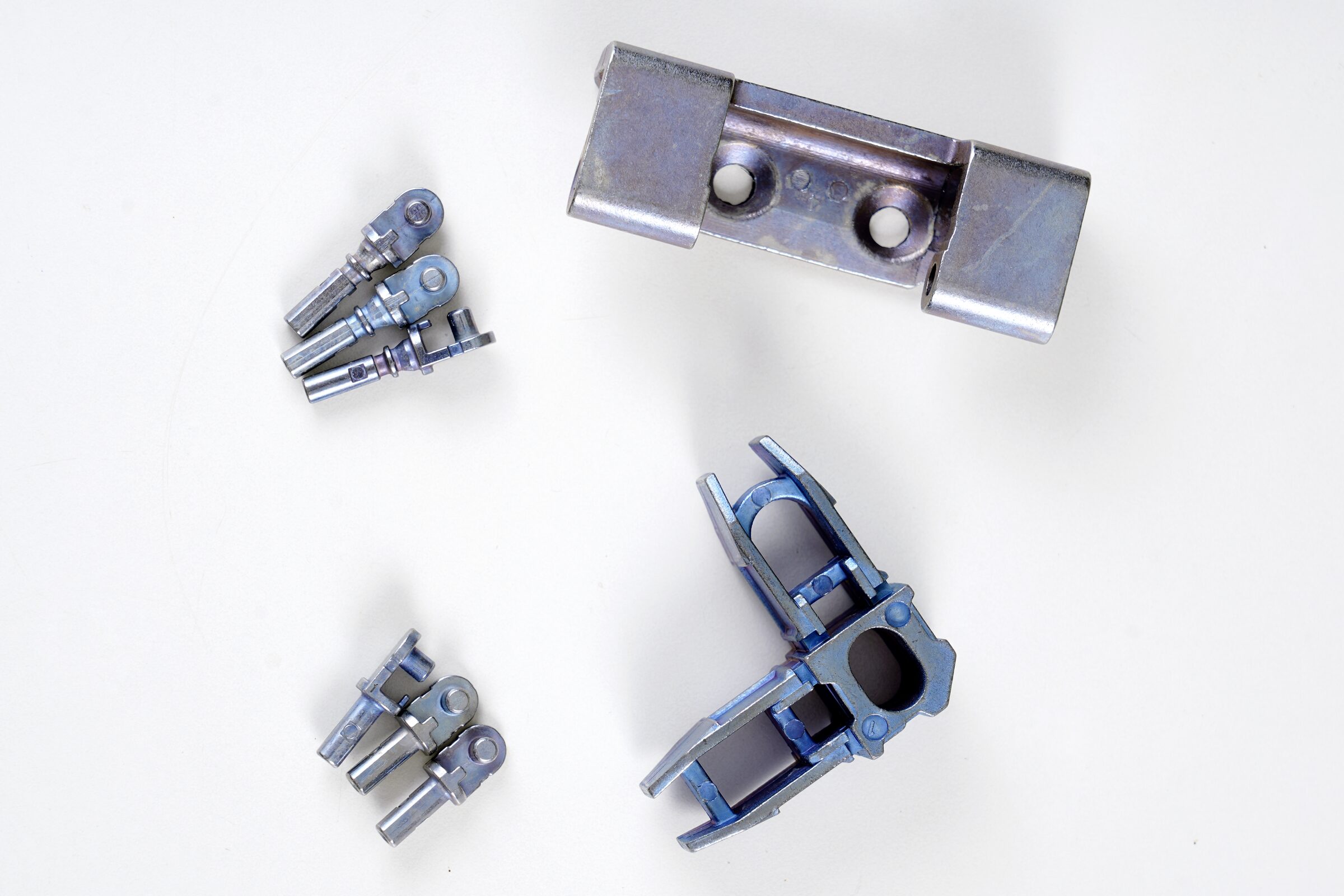
Specialist plating where substrate porosity demands precision
Pressure die cast components present unique challenges for electroplating — the porous surface structure can trap plating solution, leading to adhesion failures and blistering. Our specialised pre-treatment sequence addresses these challenges, ensuring sound adhesion and uniform coverage even on complex die cast aluminium and zinc alloy parts.
By applying zinc or zinc-nickel alloy coatings to pressure die cast components, we achieve the required white rust resistance while maintaining dimensional tolerances. Passivation processes are applied post-plating to further enhance corrosion performance.
Key benefitsSpecialist pre-treatment
Our sequence neutralises porosity traps before plating begins, preventing blistering and adhesion failures.
White rust resistance
Zinc-nickel alloy coatings achieve required white rust resistance per OEM specifications on die cast substrates.
Dimensional control
Coating thickness is tightly controlled via XRF measurement, ensuring tight tolerances are maintained post-plate.
Post-plate passivation
Passivation applied post-plating to further enhance corrosion barrier performance on the finished component.
Die cast surfaces contain porosity from gas entrapment during casting. These pores can trap plating chemistry, which later outgasses and causes blistering or adhesion loss. Our pre-treatment neutralises these traps before plating begins.
We work with pressure die cast aluminium, zinc alloys (Zamak), and other common die casting substrates. Each material requires a tailored pre-treatment sequence.
We achieve the required white rust resistance per OEM specifications through controlled plating parameters and appropriate passivation. Performance is verified via NSST salt spray testing and XRF thickness measurement on every production batch.